
Understanding the different types of diabetes
Beyond Type 1 and Type 2
When most people think about types of diabetes, they usually think of type 1 or type 2 diabetes. These are by far the most common forms.
In Australia, however, clinical guidelines recognise that diabetes is not a single condition. Instead, it is a group of related conditions that all result in higher than normal blood glucose levels—but for different reasons.
Understanding this doesn’t mean most people need extra tests or need to worry about rare types. It simply helps ensure that, when something doesn’t quite fit the usual pattern, people receive the most appropriate care.
How diabetes is classified in Australia
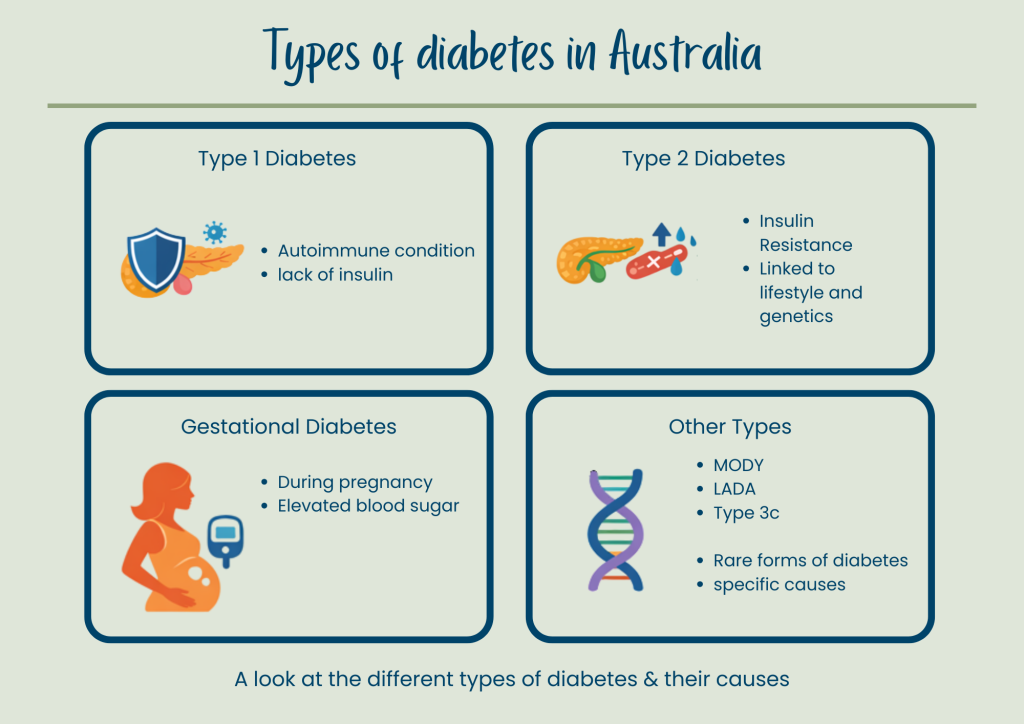
According to the International Diabetes Federation, the Royal Australian College of General Practitioners and Diabetes Australia, diabetes is grouped into four main categories:
- Type 1 diabetes
- Type 2 diabetes
- Gestational diabetes (during pregnancy)
- Other specific types of diabetes
For most people, diabetes clearly falls into type 1 or type 2, and standard assessment and routine care are all that is required.
The “other specific types” category is not something that people are routinely screened for. It is simply a clinical framework used when diabetes does not follow the usual pattern, so that care can be tailored appropriately if needed.
TYPE 1 DIABETES (INCLUDING LADA)
Type 1 diabetes is an autoimmune condition where the body’s immune system gradually destroys the insulin-producing cells in the pancreas.
A slower-progressing form, known as Latent Autoimmune Diabetes in Adults (LADA), is included within this group.
Cause
- Autoimmune destruction of insulin-producing beta cells
- Leads to eventual insulin deficiency
Diagnosis
- High blood glucose levels
- Reduced insulin production
- Often positive autoimmune markers (antibodies)
Treatment
- Insulin therapy is required
- Ongoing blood glucose monitoring
Progression
- Gradual loss of insulin production over time
- LADA progresses more slowly but usually still requires insulin eventually
TYPE 2 DIABETES
Type 2 diabetes is the most common form and develops gradually over time.
It occurs when the body becomes less responsive to insulin and the pancreas is unable to keep up with demand.
Cause
- Insulin resistance
- Gradual decline in insulin production
- Influenced by genetics, age, weight, and lifestyle factors
Diagnosis
- HbA1c, fasting glucose, or OGTT
Treatment
- Healthy eating and physical activity
- Tablets such as metformin
- Other injectable medications if needed
- Sometimes insulin
Prevention
- Maintaining a healthy weight (even 5–10% loss can help)
- Regular movement and activity
- Early management of prediabetes
Progression
- Develops gradually over time
- Treatment may need adjustment as the condition changes
MONOGENIC DIABETES (MODY)
Cause
- Inherited genetic changes affecting insulin production
Diagnosis
- Often diagnosed at a younger age
- Strong family history across generations
- No autoimmune markers
Treatment
- Depends on subtype
- Some forms need no treatment
- Others respond very well to specific tablets
Progression
- Some remain stable for life
- Others slowly progress
TYPE 3c DIABETES (PANCREATIC DIABETES)
Cause
- Chronic pancreatitis
- Pancreatic surgery
- Pancreatic disease or cancer
Diagnosis
- Diabetes with known pancreatic disease
- May include digestive symptoms or weight loss
Treatment
- Often insulin
- Sometimes pancreatic enzyme replacement
Progression
- Usually progressive
- Can be more complex due to variable glucose control and reduced hormone response
SECONDARY DIABETES
Cause
- Hormonal conditions (e.g. Cushing’s syndrome, acromegaly)
- Medications such as corticosteroids
- Genetic or medical conditions such as cystic fibrosis
Diagnosis
- High blood glucose in the context of another condition
Treatment
- Treat underlying cause where possible
- Standard diabetes medications if needed
Progression
- May improve if the underlying cause is treated
- Otherwise managed like other forms of diabetes
GESTATIONAL DIABETES
Cause
- Hormonal changes during pregnancy that reduce insulin sensitivity
Diagnosis
- Screening during pregnancy (OGTT)
Treatment
- Healthy eating and activity
- Sometimes insulin
Progression
- Usually resolves after birth
- Increases long-term risk of type 2 diabetes
NEONATAL DIABETES (RARE)
Cause
- Genetic changes affecting insulin production
Diagnosis
- Diabetes diagnosed before 6 months of age
Treatment
- Some forms respond well to tablets instead of insulin
Progression
- May be temporary or lifelong depending on cause
WHAT ABOUT TYPE 5 DIABETES?
The International Diabetes Federation has recently recognised a condition referred to as type 5 diabetes, linked to long-term undernutrition. Type 5 diabetes features a profound defect in insulin secretion rather than insulin resistance.
At this stage:
- It is not yet part of Australian clinical guidelines
- Definitions and diagnostic criteria are still being developed
WHEN TO CONSIDER A TYPE THAT DOESN’T QUITE FIT
Most people with diabetes in Australia will have either type 1 or type 2 diabetes, and in most cases, diagnosis and treatment are straightforward.
Occasionally, the pattern doesn’t quite fit the usual picture. In those situations, healthcare professionals may consider other, less common types such as:
- LADA
- MODY
- Type 3c diabetes
These are not routinely screened for. They are only considered when specific clues suggest the diabetes may not be following the usual pattern.
KEY TAKEAWAY
Diabetes is not a single condition, but a group of related conditions that all affect blood glucose in different ways.
For most people, this doesn’t change day-to-day care. But in a small number of cases, identifying the underlying type of diabetes can help ensure treatment is more precise, safer, and better suited to the individual.